Selecting the correct calibration weights is essential for ensuring the accuracy of your weighing scales.
Whether you are in an industrial, commercial, or laboratory setting, calibration weights are vital for maintaining the precision of your measurements.
Here are some guidelines to help you choose the right calibration weights:
1. Understand Your Needs
The first step is to identify the purpose of the calibration weights. Are they for calibrating high-precision analytical balances, or are they needed for industrial-scale calibration? Different uses require different classes of weights. For instance:
- Analytical Balances: Require highly precise weights, typically in the class E2 or F1 range.
- Industrial Scales: Might use weights in the class M1 or M2 range, which are suitable for higher capacity measurements but with less precision.
If your primary goal is just to verify the accuracy of your scale, you can simply purchase commonly used weights. For example, if you frequently measure 1-kilogram bags of flour, a 1-kilogram calibration weight would be sufficient to check the scale’s accuracy.
However, if you intend to “calibrate” the scale, which involves adjusting the scale’s internal settings, you need to first confirm the calibration settings of the scale itself. This usually requires consulting the vendor or manufacturer for the proper calibration method and values. If the calibration values can be set manually, we recommend purchasing calibration weights that are at least one-third of the scale’s maximum capacity to ensure effective calibration.
2. Choose the Correct Class
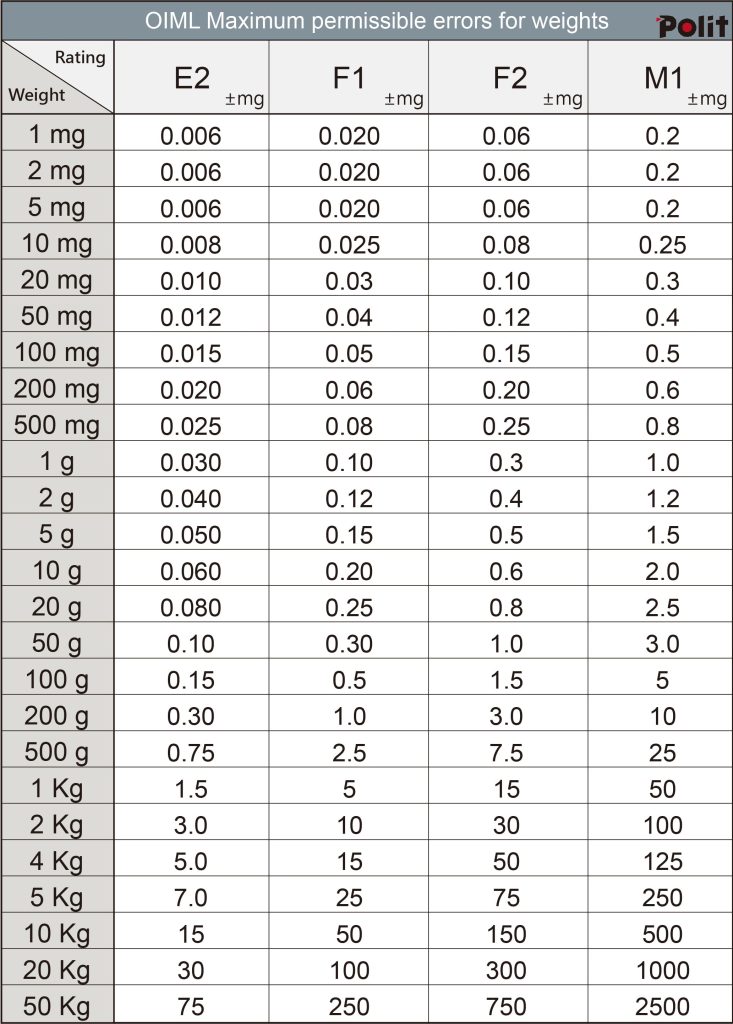
Calibration weights are classified into different classes based on their accuracy and tolerance. Common classes include:
- Class E2: High precision weights used for calibrating analytical balances and high-precision instruments. They are often used in laboratories.
- Class F1 and F2: Weights with a lower precision compared to E1 and E2, suitable for general laboratory and commercial use.
- Class M1, M2 : Typically used for industrial applications where precision is not as critical.
Selecting the right class ensures that the weights provide the necessary accuracy for your specific application.
3. Material and Construction
The material of calibration weights directly impacts their durability, accuracy, and suitability for various environments. Common materials include different grades of stainless steel, each offering unique benefits:
- 304 Stainless Steel: This is the most commonly used stainless steel for calibration weights due to its good balance of corrosion resistance, durability, and affordability. It is suitable for most general-purpose applications, including laboratory and industrial environments that are not exposed to highly corrosive substances.
- 201 Stainless Steel: While less expensive than 304 stainless steel, 201 has lower corrosion resistance. It is often used for non-critical applications where cost savings are a priority, and the environmental conditions are less demanding. However, it may not be suitable for humid or chemical-rich environments as it is more prone to rust.
- 316 Stainless Steel: Known for its superior corrosion resistance, 316 stainless steel is the material of choice for applications involving harsh chemical exposure, saltwater environments, or high humidity. It contains molybdenum, which enhances its resistance to chlorides and other industrial solvents. Although more expensive, 316 stainless steel provides the highest level of durability and longevity.
Selecting the appropriate material based on your environmental conditions and application needs is crucial for ensuring the longevity and accuracy of calibration weights.
4. Environmental Conditions
While stainless steel weights are more durable and resistant to rust compared to other materials, it is still advisable not to store them in excessively humid environments. To extend the lifespan of your calibration weights, consider using a dehumidifying cabinet or similar storage solutions to minimize moisture exposure.
Our calibration weights typically come with a plastic storage case to protect them from environmental factors. If a more durable aluminum case is preferred, it can be provided upon request for an additional cost.
5. Certification and Traceability
Ensuring that your calibration weights are accurate and reliable is essential for maintaining the integrity of your weighing processes. We provide a complimentary factory calibration report with every new calibration weight, ensuring its accuracy from the start. For customers who require a higher level of certification, we also offer the option to send the weights to an internationally recognized TAF (Taiwan Accreditation Foundation) laboratory for an additional fee.
All calibration weights should be recalibrated at least once a year to maintain their accuracy and traceability. Regular recalibration helps to ensure that your weights continue to meet stringent standards and provides peace of mind that your weighing instruments are functioning correctly.
6. Types and Forms of Calibration Weights
Calibration weights come in various types and forms to suit different weighing needs and applications:
-
Cylindrical Stainless Steel Calibration Weights:
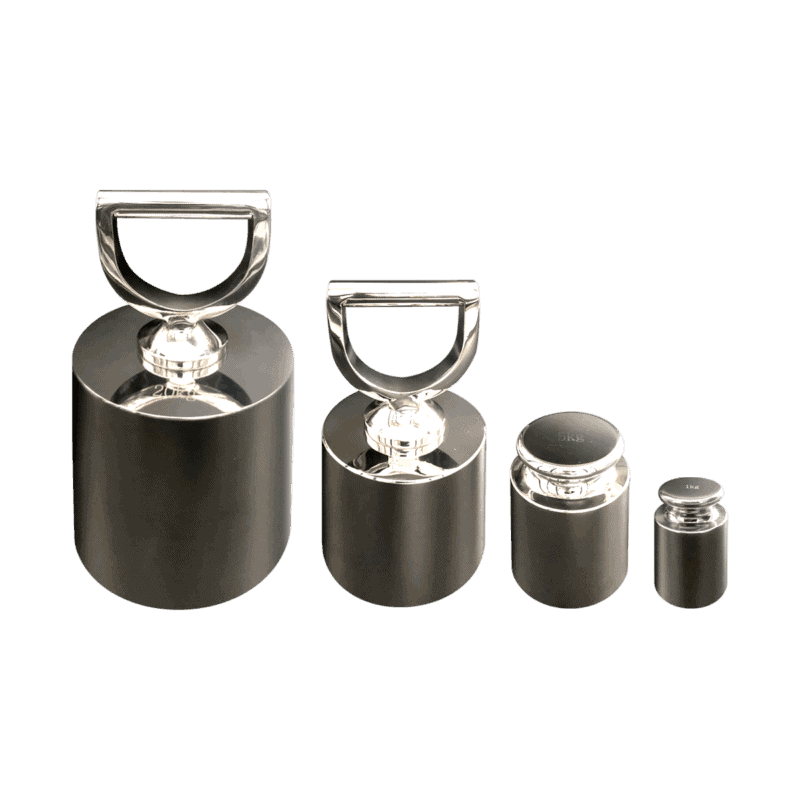
- These are the most common type and are typically used for calibrating benchtop electronic scales. They are easy to handle and offer high accuracy.
-
Double Hook/Single Hook Stainless Steel Calibration Weights:
- Ideal for scales with added hooks or those used for suspended weighing. The hooks make it convenient to attach these weights directly to the scale.
-
Lock-Shaped Non-Magnetic Stainless Steel Weights:
- These weights are designed to be non-magnetic, making them suitable for environments where magnetic interference must be avoided.
-
Laboratory Stainless Steel Weight Sets:
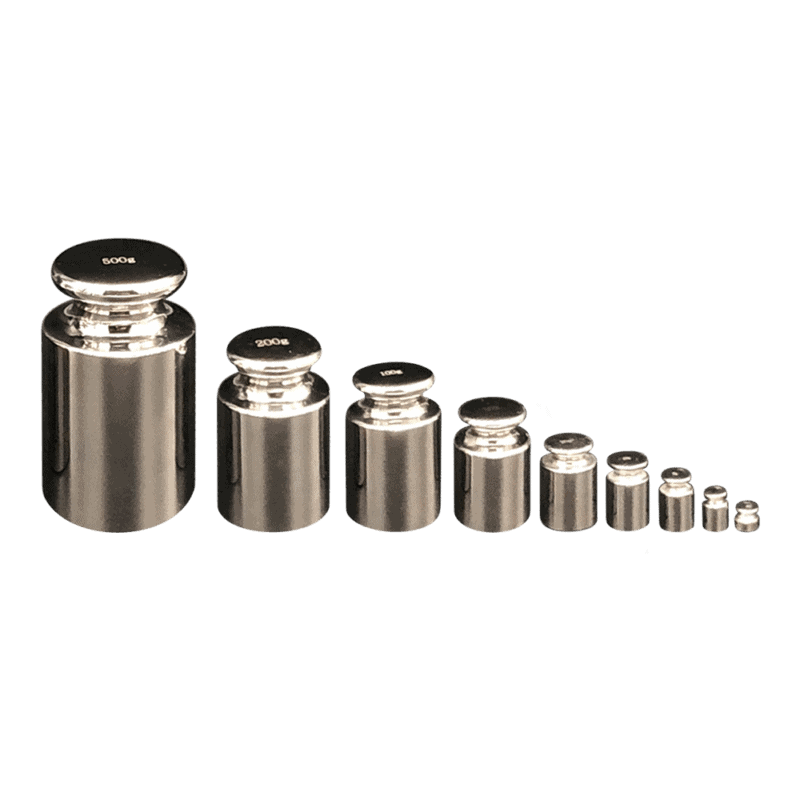
- Specifically designed for high-precision instruments, these sets often include fractional weights down to milligrams, ensuring precise calibration of sensitive laboratory equipment.
-
Custom C-Shaped Stainless Steel Weights:
- These can be customized for specific applications and are commonly used in settings requiring non-standard weight forms.
-
Portable Cast Iron Weights:
- Designed for heavy-duty use, these weights are convenient for transport and are commonly used in field calibration tasks due to their durability.
Calibration weights are usually available in standard denominations, such as 1g, 2g, 5g, 100g, 200g, and 500g. If specific weights like 300g or 400g are required, custom fabrication is available.
We also offer customization services for weights in different measurement units to cater to specific requirements.
Selecting the right calibration weights is essential for maintaining the accuracy and reliability of your weighing instruments. By understanding your specific needs, selecting the appropriate class, considering the environmental conditions, and ensuring certification and traceability, you can select the calibration weights that best suit your application.
At Polit, we offer a wide range of calibration weights to meet various requirements. Whether you need weights for industrial use, laboratory precision, or custom solutions, we are here to provide you with the best options available.