
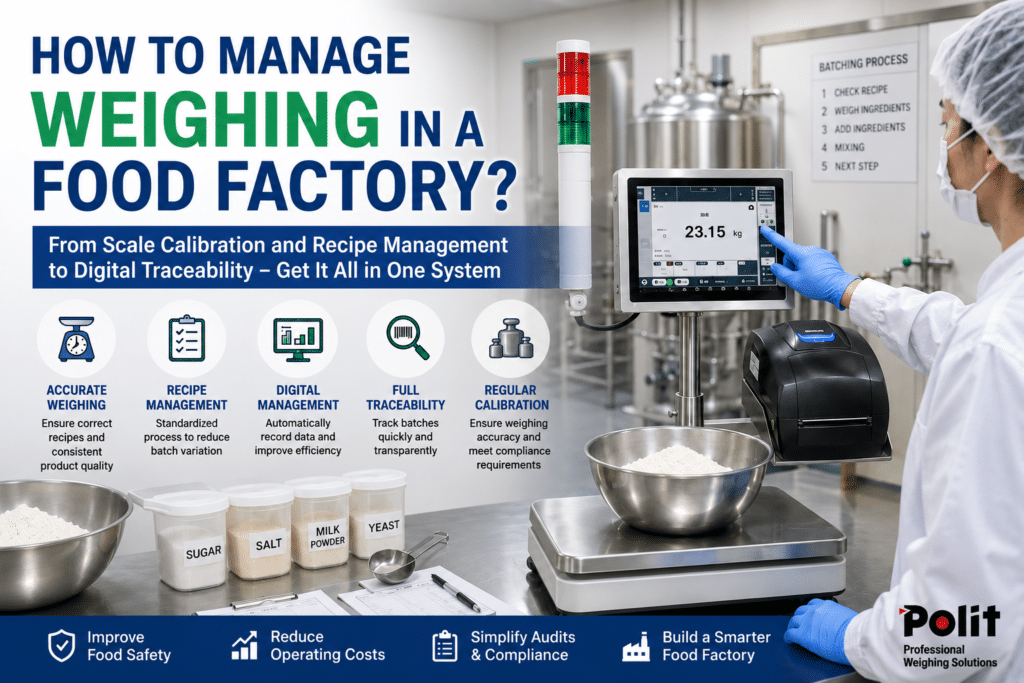
In food manufacturing, weighing may appear to be just one step in the production process. In reality, however, it plays a critical role in product quality, cost control, food safety, and regulatory compliance.
From raw material receiving and ingredient batching to production, packaging, and final shipment, accurate weighing is essential at every stage of manufacturing.
Despite its importance, many food manufacturers still rely on paper records, manually entered Excel spreadsheets, or handwritten calculations to manage weighing data. These traditional methods are time-consuming, prone to human error, and often make data retrieval difficult when it is needed most.
As food safety regulations become more stringent and manufacturers accelerate their digital transformation, establishing a reliable weighing management system has become an important strategy for improving operational efficiency, ensuring product consistency, and strengthening market competitiveness.
Why Food Manufacturers Need an Effective Weighing Management System
Weighing management involves much more than simply recording weight values.
Every weighing record may directly affect:
- Raw material costs
- Recipe accuracy
- Product quality consistency
- Production efficiency
- Food traceability
- Regulatory compliance and audit readiness
Without a well-managed weighing process, manufacturers often encounter a variety of operational challenges.
Inconsistent Recipe Execution
Incorrect ingredient quantities can result in unstable product quality, inconsistent taste or texture, and unnecessary material waste.
Human Errors in Manual Data Recording
Handwritten records and manual data entry increase the risk of transcription errors, incorrect inputs, missing records, and incomplete production documentation.
Limited Traceability
When customer complaints or quality issues occur, it can be difficult to quickly trace production records, ingredient batches, or operator information using paper-based systems.
Time-Consuming Audit Preparation
Preparing documentation for food safety certifications such as HACCP, ISO 22000, or FSSC 22000 often requires significant time and manual effort when production records are stored across multiple spreadsheets or paper documents.
Common Challenges of Traditional Weighing Management
1. Paper Records Are Difficult to Manage
Many factories still record weighing results on paper forms. Over time, this often leads to problems such as:
- Lost documents
- Illegible handwriting
- Difficult document storage
- Slow record retrieval
As production volume increases, locating historical weighing records becomes increasingly inefficient.
2. Repetitive Manual Data Entry Reduces Productivity
After completing each weighing operation, operators frequently need to perform multiple additional tasks, including:
- Recording results by hand
- Entering data into Excel
- Organizing reports
- Submitting documents for supervisory review
These repetitive administrative tasks consume valuable labor resources while adding little operational value.
3. Lack of Real-Time Production Visibility
Production managers often have to wait for:
- Daily summaries
- Weekly reports
- Monthly production statistics
before they can understand actual production performance.
As a result, when abnormalities occur, valuable response time may already have been lost.
Six Key Practices for Effective Weighing Management in Food Manufacturing
1. Standardize Your Weighing Procedures
One of the most common causes of weighing errors is inconsistent operating procedures among different employees.
Establishing standardized operating procedures (SOPs) helps ensure that every weighing task follows the same process. A comprehensive SOP should clearly define:
- Approved weighing equipment
- Standard operating procedures
- Data recording methods
- Exception handling procedures
Standardization minimizes human variation, improves operational consistency, and helps maintain stable product quality across production batches.
2. Choose the Right Weighing Equipment for Each Application
Different production processes require different types of weighing equipment. Selecting the appropriate scale for each application improves both accuracy and efficiency.
| Application | Recommended Equipment |
|---|---|
| Raw material receiving | Bench Scales, Platform Scales, Floor Scales |
| Ingredient batching | Precision Balances |
| In-line production weighing | Checkweighers / Weighing Scales |
| Packaging operations | Weighing Scales |
| Pallet shipping | Floor Scales, Forklift Scales |
Using equipment that matches the application not only improves weighing accuracy but also enhances workflow efficiency and reduces operational bottlenecks.
3. Implement Recipe Management
Ingredient batching is one of the most critical processes in food manufacturing.
A recipe management system helps standardize production by defining:
- Standard recipes
- Ingredient sequence
- Target ingredient weights
- Acceptable tolerance ranges
If the measured weight falls outside the predefined tolerance, the system can immediately notify operators, allowing corrections before production continues.
This significantly reduces batching errors, minimizes material waste, and helps ensure consistent product quality.
4. Automate Weighing Data Collection
Modern food manufacturers are increasingly integrating electronic scales with digital management systems.
Once a weighing operation is completed, the system can automatically record:
- Weight value
- Date and time
- Operator information
- Batch or lot number
- Production work order
Automatic data capture eliminates handwritten records and duplicate data entry, reducing administrative workload while improving data accuracy and operational efficiency.
5. Establish Complete Product Traceability
Traceability is one of the cornerstones of modern food safety management.
Manufacturers should maintain complete records of:
- Raw material batch numbers
- Supplier information
- Production dates
- Weighing records
- Finished product lot numbers
When quality issues, recalls, or customer complaints occur, comprehensive traceability enables manufacturers to quickly identify affected products, investigate root causes, and implement corrective actions with confidence.
6. Perform Regular Scale Calibration and Equipment Management
Many manufacturers invest heavily in production management but overlook the accuracy of their weighing equipment.
Over time, electronic scales may gradually lose accuracy due to factors such as:
- Frequent relocation
- Mechanical shock or vibration
- Changes in temperature and humidity
- Load cell aging
- Continuous heavy-duty operation
If weighing data is inaccurate, even the most advanced management system cannot produce reliable production records.
Why Is Scale Calibration So Important?
Regular calibration helps manufacturers:
- Maintain accurate weighing results
- Ensure consistent product quality
- Reduce raw material waste
- Increase customer confidence
- Meet food safety and quality management requirements
For manufacturers certified under HACCP, ISO 22000, or FSSC 22000, calibration records and measuring equipment management are also important components during audits.
Establish a Preventive Calibration Program
Calibration intervals should be planned according to equipment type, usage frequency, and operational requirements.
| Equipment | Recommended Calibration Interval |
|---|---|
| Precision Balances | Every 3–6 months |
| Industrial Weighing Scales | Every 6–12 months |
| Bench Scales | Every 6–12 months |
| Calibration Weights | Periodic verification and recalibration according to applicable standards |
In addition to scheduled calibration, manufacturers are encouraged to perform simple daily inspections before production begins, including:
- Verify that the scale returns to zero correctly.
- Confirm that the weight display is stable.
- Ensure the weighing platform is level.
- Check accuracy using certified calibration weights.
Combining routine inspections with periodic calibration significantly reduces weighing risks and helps maintain reliable production data over the long term.
Benefits of Digital Weighing Management
By integrating weighing equipment with a digital weighing management system, food manufacturers can gain greater operational visibility, improve production efficiency, and strengthen quality control throughout the manufacturing process.
Improve Operational Efficiency
Automatically capturing weighing data eliminates manual record-keeping and duplicate data entry, allowing operators to focus on production while reducing administrative workload.
Reduce Human Errors
Digital data collection minimizes transcription mistakes, missing records, and manual input errors, ensuring more accurate and reliable production data.
Strengthen Quality Control
Every production batch is supported by complete weighing records, making it easier to verify process consistency, investigate quality issues, and maintain product standards.
Simplify Audit Preparation
Historical weighing records can be quickly searched, filtered, and exported, significantly reducing the time required to prepare for customer audits and food safety certifications.
Build a Data-Driven Manufacturing Environment
Real-time production data enables managers to monitor key operational indicators, including:
- Production progress
- Raw material consumption
- Ingredient batching records
- Process deviations and exceptions
- Production reports and performance metrics
With timely access to accurate data, manufacturers can make faster, better-informed decisions while continuously improving production performance.
Building a Smarter and More Reliable Food Manufacturing Process
Effective weighing management goes far beyond measuring product weight.
From selecting the right weighing equipment and standardizing operating procedures to implementing recipe management, automatic data collection, product traceability, and regular scale calibration, every step contributes to product quality, operational efficiency, and food safety.
As food manufacturers continue to expand their operations and respond to increasingly demanding regulatory requirements, digital weighing management is becoming an essential investment rather than an optional upgrade.
A modern weighing management system not only improves production efficiency but also provides the reliable data foundation needed to support quality assurance, traceability, regulatory compliance, and continuous operational improvement.
Looking to Improve Your Food Manufacturing Weighing Process?
If your organization is experiencing challenges such as:
- Managing weighing records manually
- Difficulty tracing ingredient or production data
- Inconsistent recipe execution
- Excessive labor spent on paperwork
- Limited visibility into production operations
it may be time to modernize your weighing management process.
By combining reliable weighing equipment with an integrated digital weighing management system, manufacturers can streamline operations, improve data accuracy, strengthen food safety compliance, and build a smarter, more efficient production environment.
Whether you are upgrading an existing production line or planning a new digital transformation initiative, implementing the right weighing solution today can deliver long-term value for your business.